85%
of healthcare LLM responses contained a citation from nih.gov
By Stephanie Preyer, Head of Growth Marketing
Key Takeaways
If AI was asked about your therapy area tomorrow, would your brand be cited? As generative search reshapes how patients and clinicians find information, offsite authority has become the critical missing piece in healthcare GEO & SEO strategy. The brands building offsite authority now will be the ones AI cites in twelve months.
Search behavior is changing at a pace too fast for most healthcare marketing strategies to appropriately respond. People and patients are no longer just searching, they are asking. On platforms like ChatGPT, Claude, Perplexity, and Google AI Overviews, users type a question in natural language and receive a direct conversational answer. There are no links to scroll through. The platform answers, invites a follow-up, and keeps the user entirely within its own environment.
A good analogy to compare traditional vs AI search is this: “Google offers you a selection of doors. AI opens one and walks you through it.”
For any healthcare brand that has invested in organic search, the implications are significant. The goal is no longer to rank first. It is to be part of the answer. And the factors that determine whether your brand is included in that answer are meaningfully different from the factors that governed traditional SEO.
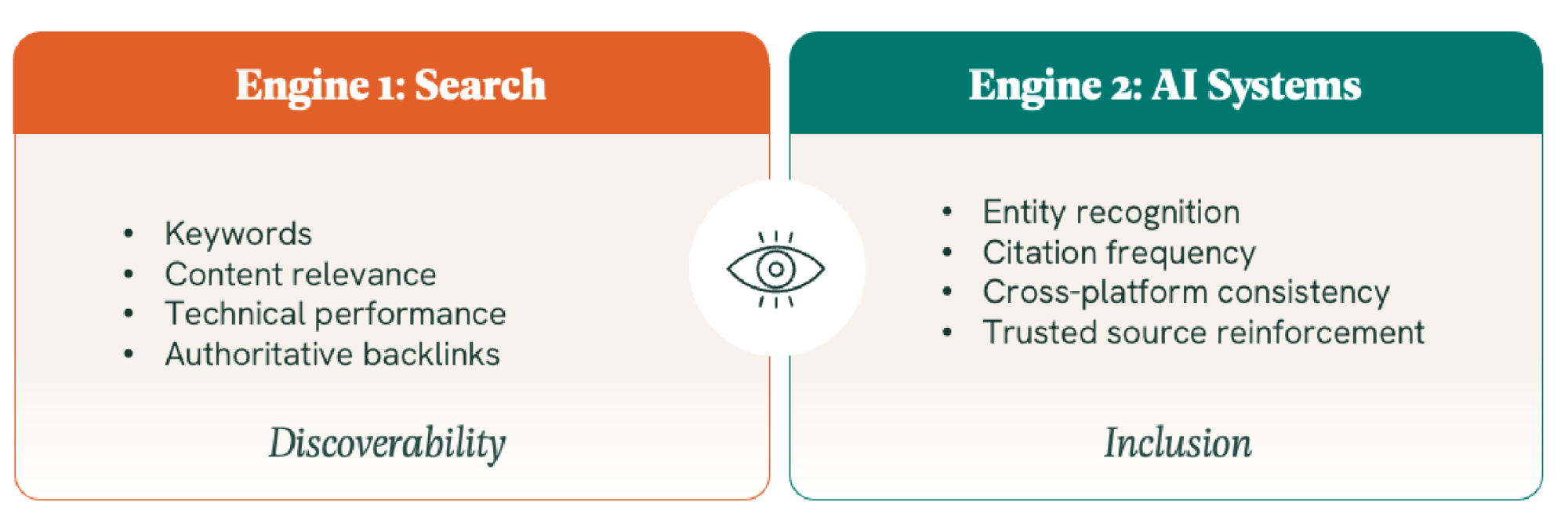
Traditional search engine optimization still matters. Keyword and topic targeting, content relevance, technical performance, page speed, crawlability, and authoritative backlinks all continue to drive discoverability on Google, Bing, and other search engines. A strong technical and content foundation is the starting point for gaining both Search and AI visibility.
But AI systems operate differently. Where traditional search rewards you for ranking well on a given page, AI systems reward you for being mentioned consistently across multiple sources. The factors that matter here are entity recognition (i.e. how clearly your brand, products, and therapy areas are identified and linked together), citation frequency across platforms, cross-platform consistency in how your brand is described, and trusted source reinforcement through key opinion leaders and authoritative publications.
AI doesn’t read pages like Google does. It reads patterns. Every piece of coverage you create is either building or fragmenting that pattern.
This is where Generative Engine Optimization, or GEO, comes in. GEO is the practice of building authority that AI systems are confident enough to cite. It sits alongside traditional SEO, complementing it, not replacing it and it demands a different kind of strategic thinking about what happens outside your own website.
The most important insight from a January 2026 SemRush LLM visibility report is this: what wins in GEO is not ranking first for a keyword. Instead, it’s being mentioned across multiple results for that keyword. When a large language model like Claude is asked a health question, it generates dozens of variations of that query, runs them through search engines, scans the top results, and identifies which brands, products, or therapies appear most frequently across all of them. The brands that appear most consistently across trusted sources are the ones that make it into the final answer.
This changes the calculus around offsite authority in a fundamental way. In traditional SEO, building authoritative backlinks into your site was a slow, months-long process that gradually improved your rankings. In GEO, the same principle applies but with a crucial difference: if your brand is being discussed consistently and credibly in the right places online, e.g. LinkedIn, YouTube, peer-reviewed journals, or industry publications, an LLM can start recommending you in a matter of days. The opportunity to build AI search visibility is faster than most teams assume.
So is the threat. A competitor who understands this and builds a strong offsite content marketing and digital PR strategy could leapfrog years of onsite investment in a matter of weeks.
A widely-cited Semrush study, based on 230 million prompts across all industries, found that Reddit is the most cited domain across LLMs overall, followed by LinkedIn, Wikipedia, and YouTube. For teams building a content marketing and digital PR strategy, this might suggest that a Reddit presence is the priority. In practice, for most healthcare brands, it’s not.
Engaging authentically and compliantly on Reddit as a healthcare brand is extremely difficult. More importantly, when Everybody Agency ran LLM visibility benchmark analyses specifically for healthcare clients (running thousands of prompts across patient and HCP queries) the citation picture looked very different from the cross-industry average.
An initial analysis of the data showed:
of healthcare LLM responses contained a citation from nih.gov
of responses included a YouTube citation across all journey stages
of healthcare queries on Google now trigger an AI Overview
NIH dominated healthcare responses, appearing in 85% of prompt answers. YouTube appeared in 60% of responses and this was not just for patient queries. YouTube citations for HCP prompts grew from the awareness stage through to treatment decision stages, consistently outranking Healthline, WebMD, and even Mayo Clinic. Academic journals, charitable associations, and national health bodies also featured heavily. Reddit, by contrast, was rarely cited in the healthcare-specific data.
Note: the above insights are based off a subset of data; the full report will be available in August 2026.
The practical implication is clear. For healthcare brands, the most valuable offsite content marketing investments are scientific journal publications, YouTube video content optimized for LLM retrieval, LinkedIn thought leadership content in long-form article format, industry editorial partnerships, and citations from key opinion leaders. These are the platforms and source types that AI systems trust most when answering health queries.
The YouTube finding deserves particular attention because it surprises most healthcare marketing teams. The assumption has long been that video is primarily a consumer or patient channel. Our proprietary data from 1,200 prompts across HCP and patient queries, covering four different journey stages and two different markets, tells a different story.
YouTube was cited in the top five sources across every journey stage for HCPs as well as patients. For clinicians evaluating treatment options, video content was surfacing at the decision stage, not just the awareness stage. This means that if your YouTube content is not optimized for LLM retrieval, that is, with consistent naming, keyword-rich chapter headings, links to educational landing pages, and an accurate transcript, you are missing one of the most effective and fastest-acting levers available in GEO. A verified transcript in particular creates a rich source of entities, terminology, and context that AI systems can extract and use directly in responses.
One important nuance for healthcare brands: YouTube content needs to be publicly accessible to be indexed and cited by LLMs. Unlisted videos are not surfaced in YouTube search and are therefore far less likely to be found by AI crawlers. If videos are unlisted for process rather than regulatory reasons, it is worth reviewing whether they can be made public.
LinkedIn is the second major platform that healthcare brands should prioritize for AI and SEO visibility. Approximately 66% of the LinkedIn content that appears in LLM responses comes from long-form articles of 500 to 2,000 words, not short status updates or quick announcements. The implication for any thought leadership content marketing strategy is straightforward: if your LinkedIn activity is dominated by short posts, it is contributing very little to your GEO authority, regardless of how much engagement those posts generate on the platform itself.
Executives, medical affairs leads, and clinical spokespeople publishing coordinated long-form articles on therapy area impact, patient outcomes, and clinical innovation – using consistent product and therapy area terminology throughout – is the kind of LinkedIn activity that actually builds AI visibility. Each article reinforces the entity relationships between your organization, your brands, and the therapy areas you operate in.
The most effective offsite authority strategies are embedded into campaign workflows from the outset, not added as an afterthought at the end. When planning any offsite campaign, there are four moments that determine whether it will build meaningful GEO authority.
Campaign ideation: define the entity relationships you need to strengthen
Before deciding what content to create, identify which associations you want LLMs to make between your brand, your products, and your therapy areas once the campaign has run. This shapes every subsequent decision about channel, language, and format.
Channel selection: go where AI already looks
Choose channels based on which sources AI systems cite most frequently for your therapy area, not just where your audience is. For healthcare, that means prioritizing journal publications, YouTube, LinkedIn long-form content, and high-authority industry editorial, in that order.
Publisher briefing: control the language
Brief journalists, editorial partners, and key opinion leaders with the exact product name, therapy area terminology, and clinical context you want them to use, ideally in the opening sentence of any piece of coverage. The language used in earned media directly trains the machines.
Amplification: close the loop
No piece of coverage should exist in isolation. When a journal article, media placement, or expert quote goes live, feed it back through your own channels, e.g. LinkedIn reposts from key opinion leaders, a video summary embedded on a relevant landing page, internal newsletter coverage. Authority compounds through coordinated repetition across trusted ecosystems.
One of the most important shifts in thinking about offsite content marketing is to map activity by journey stage, not just by audience type. The channels and source types that matter at the awareness stage (when a patient is researching symptoms or a clinician is first encountering a new therapy area) are different from those that matter at the treatment decision stage.
An LLM visibility audit that runs hundreds or thousands of prompts specific to your brand and therapy areas will show, by journey stage, which websites are most frequently cited and where building partnerships will have the most impact. Brands that run this kind of audit typically discover they are highly visible in some therapy areas and almost absent in others — and that the pages on their own website receiving the most LLM referral traffic reveal a pattern about what kind of content AI systems trust most from their domain.
Clicks through to your website can no longer be the primary metric for assessing the impact of your organic strategy. When 88% of healthcare queries on Google trigger an AI Overview, a significant portion of your brand’s influence happens before any user clicks anywhere. Measuring that influence requires a different set of signals.
In the first three months of a GEO SEO offsite program, the metrics to establish as a baseline are referring domain growth, site authority score, citation share in LLM responses for branded queries, and brand mention frequency across editorial sources. Google AI Overview appearances for target queries will start to increase, and LLM citation frequency for branded searches (which is easier to build than non-branded) will begin to grow.
Between three and twelve months, the compounding effects become measurable: growing domain authority, increased high-quality referring domains, appearances in unbranded therapy area queries, and a growing competitive share of voice in both search and LLM responses. LLM referral traffic, trackable directly in GA4, also begins to matter at this stage, not because the volume is large, but because the conversion quality is exceptional. Visitors arriving from LLM referrals convert at approximately 4.4 times the rate of organic search visitors, because they arrive pre-qualified after a back-and-forth conversation with the platform.
Run a manual LLM visibility check. Query your top three therapy areas through ChatGPT, Perplexity, Claude, and Google AI Overviews. Note which brands are cited, which sources are referenced, and whether your own brand appears. This takes thirty minutes and gives you an immediate baseline.
Apply an authority checklist to your next campaign before it goes out. Does this activity earn a third-party link, mention, or citation? Does it reinforce your entity relationships? Is an external expert cited? Is product naming consistent across all outputs? Does it have a plan for amplification?
Review LLM referral traffic in GA4. Identify which pages on your site are receiving the most traffic from AI platforms, and use that data to understand what kind of content is working best for GEO retrieval. Apply those learnings across the rest of your site content.
Zero click does not mean zero impact. A mention, a citation, a press release, all of it trains the machines. The brands that understand this, and build their offsite content marketing and digital PR strategy around it, will be the ones AI cites when patients and clinicians are looking for answers.
If you’d like support with your AI visibility and GEO strategy, we’re here to help. Contact us to talk through your needs.
Contact UsReferences: