Optimising YouTube for healthcare AI answers
OCTOBER 28, 2026

By Stephanie Preyer, Head of Growth Marketing
AI is already watching your videos
When a patient asks ChatGPT about a new heart failure device, or an HCP asks Google’s AI Mode how a therapy works, the answer may cite a YouTube video. The question for healthcare brands is whether that video explains the subject accurately, and whether it comes from a source they recognise.
In our own research across more than 3,000 healthcare prompts, 61.1% of AI-generated responses included at least one YouTube citation. YouTube was also among the five most-cited sources across journey stages for both patients and HCPs.
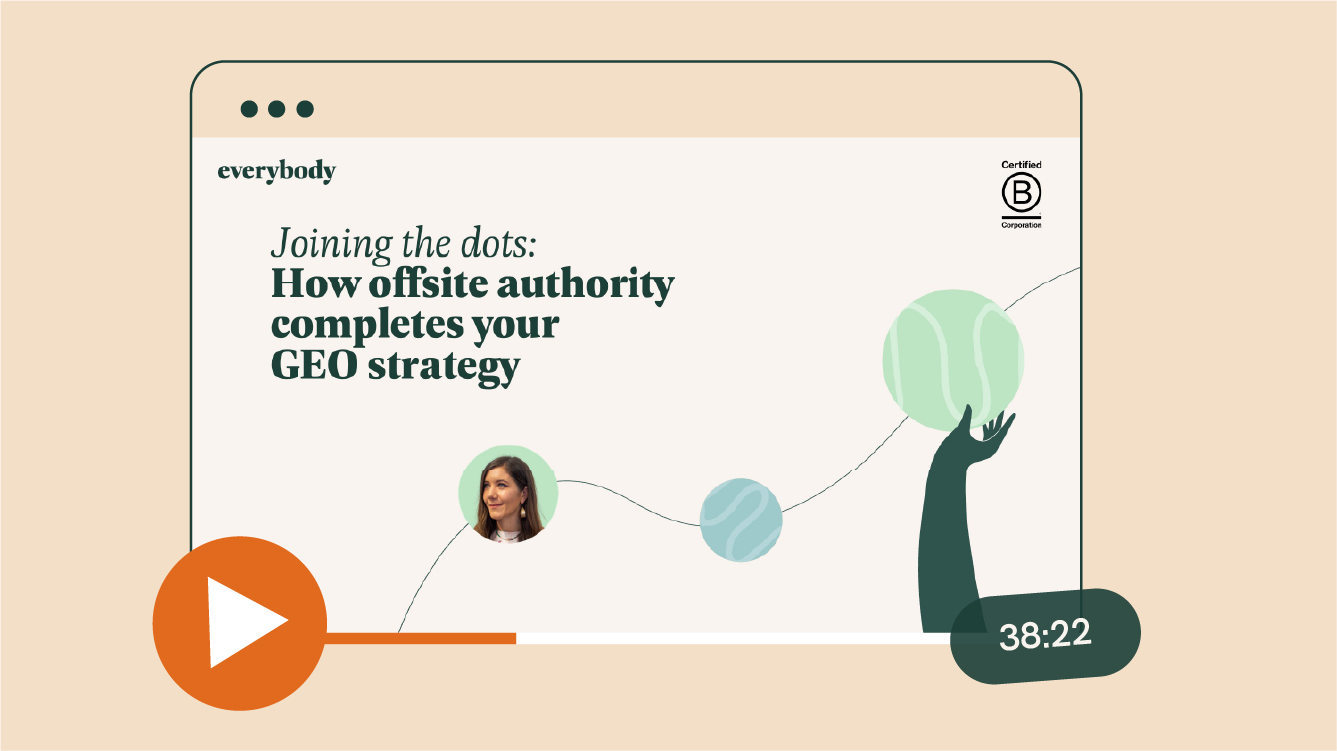
We explored YouTube’s role in offsite authority in Joining the Dots, then examined the sources AI surfaces for patients and HCPs in our healthcare citation research. This article is the practical follow-on: how to make your existing videos easier to find, interpret and potentially cite.
The good news for pharma and med tech brands is that the biggest gains rarely need new content. Optimising metadata and naming consistency on existing videos is the lowest-effort, highest-impact action available.
YouTube is a core healthcare source for AI
We are not the only ones seeing this. Independent research is showing the same pattern.
YouTube outranks medical sites in health AI Overviews
In September 2026, Suff Digital analysed 4,248 AI answers to 548 US health-related questions across ChatGPT, Gemini, Google AI Mode and AI Overviews. YouTube appeared in 28.4% of answers that cited at least one source, compared with 26.7% for NIH.gov. The questions covered general health, nutrition, mental health and sleep, rather than a pharma or med tech-specific sample.
AI citations do not follow organic rankings
AI citations also do not map neatly to conventional organic rankings. In a separate, cross-industry Ahrefs analysis of four million Google AI Overview citation URLs, only 37.1% also ranked in the organic top 10 for the same query. YouTube URLs outside the organic top 100 accounted for 5.6% of all citations in that dataset. Search visibility remains important, but ranking for the exact query is not a guarantee of being cited.
YouTube mentions are strongly linked to brand visibility in AI
The connection goes beyond direct citations. Ahrefs analysed 75,000 brands and found that YouTube brand mentions (in titles, descriptions and transcripts) had the strongest correlation with AI brand visibility among the factors tested, at approximately 0.74. This was consistent across ChatGPT, AI Mode and AI Overviews, and well ahead of backlinks.
These studies show correlation, not causation. But together with our own healthcare data, they point the same way: if your brand is not present and clearly described on YouTube, you are missing one of the sources AI relies on most.
Why video optimisation matters more in healthcare
In most sectors, a poorly described video is a missed opportunity. In healthcare, it can mean patients and HCPs get an incomplete or inaccurate picture of your therapy.
Our research found YouTube appears more often in patient answers, but also features prominently in HCP answers across the therapy areas we studied, alongside medical and academic sources. That makes video relevant beyond awareness campaigns: disease education, mechanism-of-action explainers, procedure videos and clinical discussions may all have a role to play too.
The opportunity for pharma and med tech brands is clear: if you don’t give AI accurate, well-labelled video content about your therapy, it will use someone else’s.
If you don’t give AI accurate, well-labelled video content about your therapy, it will use someone else’s.
How AI interprets a video
AI systems do not all process YouTube videos in the same way. Titles, descriptions, captions, transcripts and chapters provide useful textual context for search and retrieval. Some multimodal systems can also analyse the audiovisual content itself: for example, Google documents the ability of its Gemini API to process public YouTube videos. Combined with Google’s existing video search infrastructure, this may help explain why our own research found YouTube was cited more frequently in Google AI Mode than in other LLM platforms.
OtterlyAI’s March 2026 study reviewed more than 100 million AI citation instances across several platforms and then analysed YouTube videos that were already being cited. It is cross-industry rather than healthcare-specific, but the findings are useful:
Descriptions matter most
the average description length of cited videos. Description length had the strongest link with repeat citation.
Popularity matters very little
of cited videos had fewer than 1,000 views. Views, likes and subscriber numbers showed almost no relationship with citation.
Long-form wins
of YouTube citations were long-form videos (over five minutes in this study), compared with under 6% for Shorts.
Chapters help in Google
Videos with timestamps were often cited repeatedly, sometimes across several chapters, but only in Google’s AI Overviews and AI Mode.
Source: OtterlyAI, March 2026. 100M+ AI citation instances, cross-industry.
For healthcare brands, this is encouraging. You don’t need a huge channel or viral reach to be cited. A modest channel with clear, well-structured, accurate content can compete.
Seven ways to optimise your videos for AI
To show how this works in practice, we’ll use a fictional example: a deep dive video from Veridia Medical on how its CORREVAX™ heart failure device works.

1. Align titles with priority therapy terms
Use the words patients and HCPs actually search for, not just the brand name. "How CORREVAX™ Works: Mechanism, Clinical Evidence and Patient Selection" tells AI what the video covers far better than "CORREVAX™ Deep Dive". Include the condition (heart failure) and the therapy type (device therapy) where it reads naturally.

2. Write descriptions that explain the relevant entity relationships
The description is the most important text AI reads. Spell out the relationships between the product, the therapy area, the indication and the audience. For example: "CORREVAX™ is an endocardial restoration system for patients with heart failure caused by ventricular dyssynchrony. This video is intended for healthcare professionals." Aim for a full, well-structured description, not one line and a list of hashtags.

3. Link to approved supporting information
Link to the pages you want AI and users to reach next, such as the product page, clinical evidence summary or HCP portal. This connects the video to your owned content and reinforces which site is the authoritative source.

4. Keep naming consistent across channels
Use exactly the same product, therapy and indication names in the video, the description, the transcript, your website and your press materials. As we covered in Joining the Dots, inconsistent naming weakens how AI connects your brand to a condition. Watch out for abbreviations, old product names and regional variations.

5. Name and credential expert speakers
Where a clinician or scientist appears, name them and state their role and credentials on screen and in the description. AI favours content from identifiable, trusted sources. Eligible healthcare organisations may receive YouTube health-source information panels, but YouTube currently excludes pharmaceutical-company and medical-device-company channels from applying for those features. Expert identification remains valuable for transparency even without a platform badge.

6. Add descriptive chapters and review captions
For longer videos, add chapters based on the questions each segment answers - for example, “Device design”, “Clinical evidence” and “Patient selection considerations”, rather than “Part 2”.
Review YouTube’s automatically generated captions for drug names, device names, abbreviations, dosages, clinical terminology and speaker identification. You can edit automatic captions in YouTube Studio or upload an approved caption file. This helps viewers as well as any systems that use those textual representations.

7. Connect YouTube to your owned content
Where appropriate, embed public videos on relevant website pages and provide a medically reviewed summary or transcript alongside them. Use accurate video titles and descriptions on the page; consider VideoObject structured data when the page and video meet Google’s eligibility requirements.
Healthcare compliance comes before visibility
It goes without saying that metadata changes are content changes. Adding a therapy claim, indication, patient population or call to action to a title or description can change how a communication is classified, even when the underlying video has already been approved. Medical, legal and regulatory (MLR) review should therefore cover the video and the surrounding metadata, links, captions, market targeting and publication setting.
Public, unlisted or private: what it means for discovery
This is one of the questions we are asked most often. The short answer: if a video is unlisted or private, you should assume AI will not find or cite it.
AI tools mostly discover YouTube content the same way people do, through search indexes and YouTube’s own discovery features. Unlisted and private videos are deliberately removed from those routes.
| Setting | Who can watch | YouTube discovery | Potential for AI citation |
|---|---|---|---|
| Public | Anyone | Can appear in search, recommendations and channel | Yes, if well optimised |
| Unlisted | Anyone with the URL | Normally absent from search; public playlists are an exception | Unlikely |
| Private | Only invited viewers | Not shown publicly | No |
Source: YouTube Help, “Change video privacy settings”.
- Unlisted is not secure access control. A link can be copied, embedded or posted publicly. If material genuinely requires HCP verification, use an appropriately gated environment rather than relying on an unlisted YouTube URL.
- Private content can be shared with invited viewers. It is not publicly searchable, and private embeds can’t be viewed by the public, so they have no route to AI visibility.
- Older libraries need checking. In July 2021, YouTube switched certain unlisted videos uploaded before 1 January 2017 to private unless the channel owner opted out.
So, should you make your videos public?
Not always. In pharma especially, there are often good reasons to keep a video unlisted. The right question is: does this video need to be found by people who don’t already have the link?
- Yes, make it public for disease awareness, mechanism of disease, procedure explainers, med tech device education and corporate or pipeline content that is suitable for a general audience.
- Keep it unlisted or private for prescription medicine patient support content, HCP-only promotional material and anything that has only been approved for a specific audience or channel.
- If it must stay unlisted, put the substance somewhere AI can see it. Publish an approved, non-promotional version of the key information on a public page or a public video, with the same consistent naming. That way the AI answer draws on content you control, rather than a third party’s interpretation.
We often find clients have valuable, already approved videos sitting unlisted for no strong reason, sometimes because that was the default when they were uploaded. A quick review with your medical, legal and regulatory team can unlock these with very little extra effort.
Start with what you already have
Most healthcare brands already have a library of approved videos. The quickest wins come from making that library easier for AI to understand, not from producing more content.
-
1
Audit your existing videos. Review titles, descriptions, transcripts, chapters, naming and visibility settings against the seven points above.
-
2
Prioritise by impact. Start with videos already being cited in AI answers, then those covering your priority therapy terms and journey stages.
-
3
Fill the gaps. Map what remains against the patient and HCP journey, and plan new content only where there is a clear gap. Optimise what you have before commissioning new video content.
-
4
Build review into maintenance. Set an owner and review date so clinical changes, safety updates and product changes are reflected in both the video and its associated metadata.
Measuring success
Views and subscribers tell you little about AI visibility. Instead, track:
- How often your videos are cited in AI answers for your priority prompts, across ChatGPT, AI Overviews, AI Mode and Perplexity. You can do this using an LLM tracking tool such as Profound, AccuLLM or SEMRush.
- Whether AI describes your product, therapy and indication accurately
- Your share of YouTube citations compared with competitors and third-party channels
- Referral traffic from AI tools to the pages linked in your description
Three things you can do this week to increase the AI visibility of your video content

Pick your five most important videos and check their visibility setting. Are any unlisted without a clear reason?
Review and correct the captions on one important video, especially product names, clinical language and medical terminology.
Rewrite one description to identify the actual topic, intended audience, approved terminology and relevant next-step resources; submit the changes through the appropriate review process.
Want to know whether your video content is appearing in AI-generated healthcare answers? Explore our healthcare AI citation research or speak to Everybody Agency about an AI visibility audit.
Get in touch
If you’d like support with your AI visibility and strategy, we’re here to help. Contact us to talk through your needs.
Contact Us
References & further reading
- Everybody Agency — Joining the Dots (offsite GEO/SEO)
- Everybody Agency — Healthcare AI Sources Report
- Suff Digital — US AI health citations (2026)
- Ahrefs — Brand visibility correlations (2025)
- Ahrefs — AI Overview citations vs rankings (2026)
- Google — AI features and SEO guidance
- OtterlyAI — YouTube citation study (2026)
- Google — Gemini video understanding
- Google — Video structured data
- YouTube Help — Edit or Remove Captions
- YouTube Help — Video Chapters
- YouTube Help — Privacy settings
- YouTube Help — Health-source eligibility
- YouTube Help — Older unlisted videos